 Save
Save I discovered the beauty of arranged simplicity one autumn evening when a friend challenged me to create something that was as much art as it was nourishment. That's when the Infinity Loop Flow came to life—a dish that transforms humble salmon, vibrant vegetables, and pearl couscous into an elegant figure-eight that tells a story with every component. The first time I plated it, I realized that food arranged with intention tastes better, not just because it looks beautiful, but because it forces you to slow down and appreciate each element.
I remember cooking this for my family during a moment when everyone felt scattered and distant. Something about arranging food into that continuous loop seemed to bring us back together—we sat around the table, each person discovering their own path through the ingredients, and suddenly we were all present again. That's when I knew this recipe was special.
Ingredients
- Fresh salmon fillets (about 300 g): Choose skinless fillets that are firm to the touch; they should smell like the ocean, not fishy. The salmon is the anchor of this dish, so invest in quality—it's worth it for how it flakes into delicate, elegant pieces.
- Pearl couscous (1/2 cup): This isn't the fine couscous your grandmother used; pearl couscous has a delightful chewy texture that holds its shape beautifully when you arrange it. It's the canvas for everything else.
- Zucchini, carrot, and fennel: Slice these as thinly as you can manage—a mandoline slicer changed my life here, but a sharp knife and patience work just as well. The thinness matters because it lets them cook quickly and arrange gracefully around the loop.
- Baby spinach: This wilts into tender pockets of green that catch the dressing and create visual contrast. Use fresh spinach, not frozen—texture is everything on this plate.
- Greek yogurt (2 tbsp): This becomes your dressing's base, lending creaminess without heaviness. It's the unexpected touch that makes people pause mid-bite and ask what that flavor is.
- Lemon zest and fresh dill: These aren't garnishes; they're the voice of the dish. Fresh dill especially brings an herbaceous brightness that ties everything together.
- Capers and toasted pine nuts: The capers add briny pops of flavor scattered throughout, while pine nuts bring warmth and a subtle richness that anchors each bite.
- Olive oil (1 tbsp), salt, and pepper: Use good olive oil—nothing fancy, but something you'd enjoy on its own.
Tired of Takeout? 🥡
Get 10 meals you can make faster than delivery arrives. Seriously.
One email. No spam. Unsubscribe anytime.
Instructions
- Heat your oven and start the couscous:
- Preheat your oven to 180°C (350°F)—you want it warm and ready. Meanwhile, bring that vegetable broth to a rolling boil in a small saucepan. There's a quiet satisfaction in hearing it come to life. Add the pearl couscous, let it bubble for just a moment, then lower the heat, cover it, and let it steam gently for 10 minutes. You're not cooking it aggressively; you're coaxing it to tenderness. When it's done, fluff it with a fork so each grain stands separate.
- Blanch your vegetables until they're just barely tender:
- Fill a pot with salted water and bring it to a boil—salt it like the sea. Have a bowl of ice water ready beside your stove. Working quickly, slip the zucchini slices in first, then the carrot, then the fennel. Watch them; you're looking for that moment when they shift from raw to tender-crisp, which takes barely 1–2 minutes. Don't walk away. Fish them out with a slotted spoon and plunge them into the ice water immediately. This stops the cooking and locks in that jewel-bright color. Pat them completely dry when you're done; water is the enemy of beautiful plating.
- Bake the salmon until it just yields to gentle pressure:
- Rub your salmon fillets with olive oil—let your fingers work it in, feeling the fish begin to soften. Season generously with salt and pepper. Line your baking tray with parchment paper (trust me on this; cleanup will thank you). Lay the salmon skin-side down and slide it into the oven. Bake for 12–15 minutes. The salmon is done when a fork gently flakes it and the thickest part is just opaque. Undercook it slightly if you're unsure; residual heat will finish it. Let it cool for a few minutes, then break it into large, beautiful flakes—these aren't tiny crumbles; they're the jewels of your plate.
- Make your yogurt dressing with brightness:
- In a small bowl, combine Greek yogurt, lemon zest, and fresh dill. Stir gently. Taste it. Does it need more lemon? More dill? This dressing should taste bright and herbaceous, like a promise of spring. You'll dot this throughout the loop, so don't be shy with it.
- Arrange your infinity loop with intention:
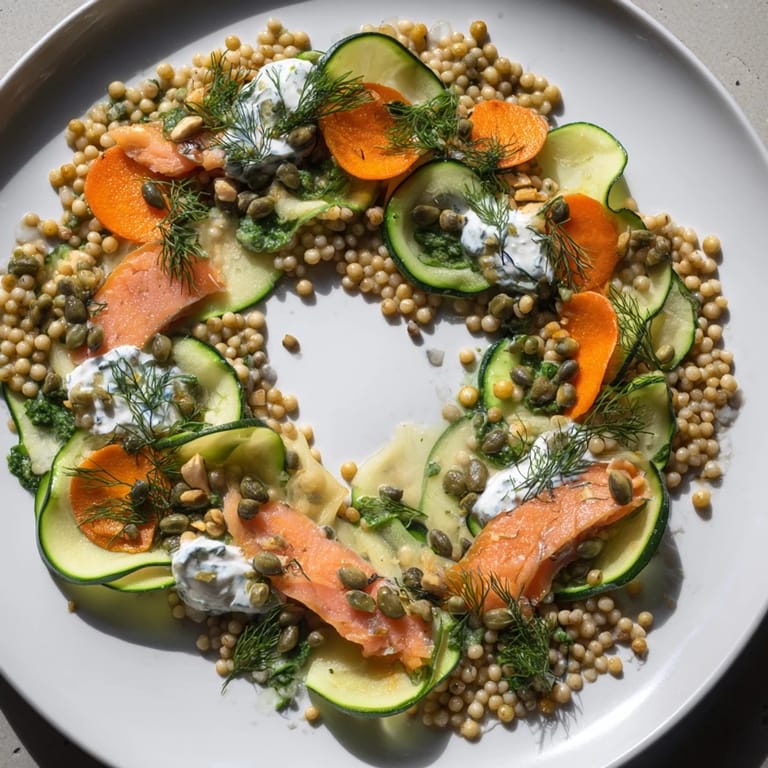
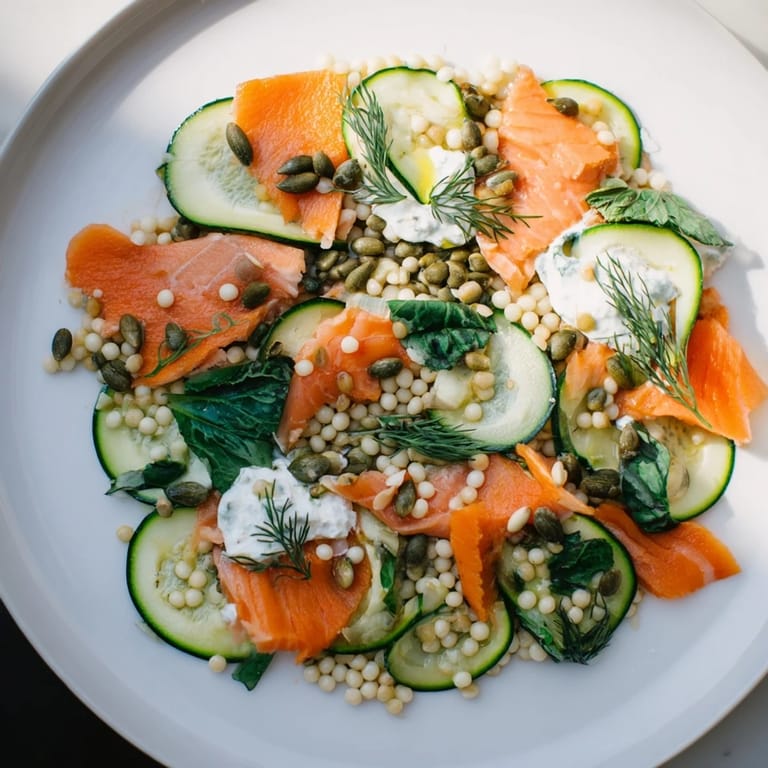
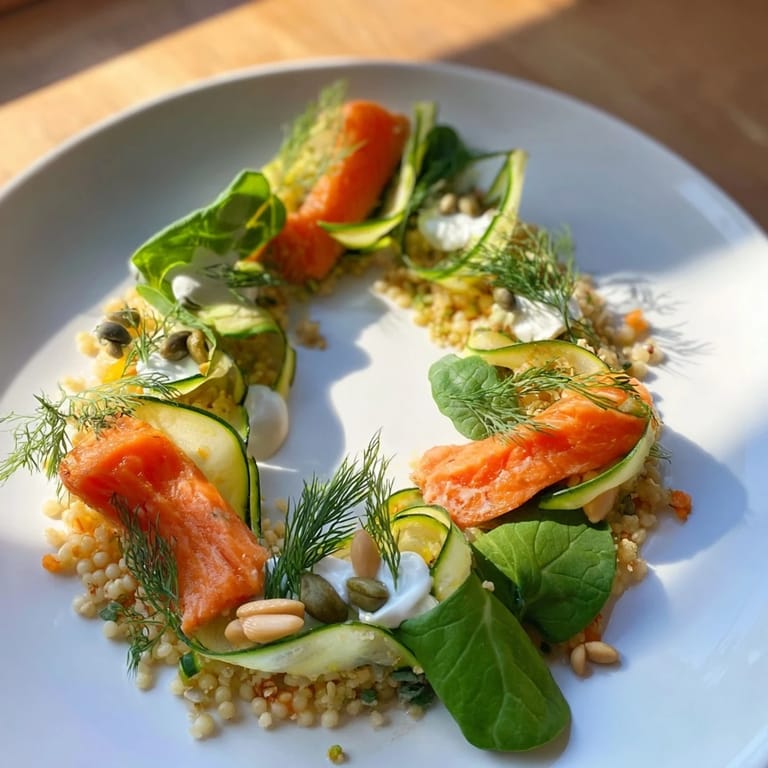
- This is the moment where cooking becomes art. On your large platter, spoon the pearl couscous in a continuous figure-eight shape. Don't rush this; let your hand move slowly and deliberately. Now, along the curves of that loop, arrange your blanched vegetables and spinach. Alternate colors—the pale green of zucchini, the sunset orange of carrot, the pale fennel, the darker spinach. Each curve of the loop should feel like a brushstroke. Nestle those salmon flakes into the spaces, distributing them evenly so the infinity loop feels balanced. Scatter capers where they'll surprise you. Dot the yogurt dressing throughout. Finally, shower toasted pine nuts over everything. Step back. Look at it. You made that.
- Serve while everything is at its best:
- Bring this straight to the table. Serve immediately so the couscous is still warm, the vegetables still bright, and the dressing still creamy. Each person should capture a bit of everything on their fork—salmon, vegetable, couscous, dressing, all at once.
 Save
Save I watched my partner take the first bite of this dish, fork carefully positioned to capture all the elements at once, and their entire face changed. They paused and said something like, 'This is almost too beautiful to eat.' Almost. But then they did eat it, and they understood that food this beautiful tastes even better because you've already fallen in love with it first.
Why Arrangement Matters in Pescatarian Cooking
When you're cooking with fish and vegetables as your stars, presentation becomes a language. The infinity loop isn't just beautiful; it's functional. That continuous figure-eight shape means that as you eat, you travel through the entire flavor journey without your plate becoming a mixed medley. Each curve introduces you to a new element, a new texture, a new conversation between ingredients. I've learned that in pescatarian cooking especially, when you're not building on the richness of meat, you're building on contrast and visual interest. The eye eats first, and when your guests see this plate, they're already halfway to loving it.
Customizing for Your Pantry and Preferences
This dish is more flexible than it appears. If you don't have pearl couscous, try farro or even wild rice—anything with texture and a slightly nutty flavor will work. The salmon can be swapped for trout, cod, or even halibut depending on what your fishmonger has that day and what speaks to you. If someone at your table avoids tree nuts, leave out the pine nuts or replace them with toasted sunflower seeds. I once made this with thin slices of roasted beet instead of carrot, and the earthiness was stunning. Let your vegetables guide you. Whatever's at the farmers market at peak season is the right choice.
The Quiet Joy of Cooking for Others
There's something transformative about taking time to arrange food this carefully. It says something wordless to the people you're cooking for: I see you. You're worth this attention. This dish has become my favorite thing to make when I want to celebrate without making a big announcement about it. It works for date nights, for family dinners, for that moment when you want to remind everyone at the table that ordinary Tuesday nights can become extraordinary.
- Prep your vegetables ahead of time if you need to—they'll keep for a few hours in the fridge and you'll have less stress right before serving
- Make the yogurt dressing in advance and let it sit for a bit so the flavors get to know each other
- The most important part happens on the platter, not in the oven—take your time with the arrangement and trust that it will be worth it
 Save
Save Make this dish because it reminds you that cooking isn't just about feeding people; it's about telling them they matter. That's the real infinity loop—the way food circles back to us, nourishing not just our bodies but our sense of connection.
Recipe FAQs
- → How is the salmon prepared for this dish?
The salmon is rubbed with olive oil, seasoned with salt and pepper, then baked until just cooked, then lightly flaked for delicate layering within the dish.
- → What is the purpose of blanching the vegetables?
Blanching briefly softens the zucchini, carrot, and fennel while preserving their vibrant colors and crisp texture for visual appeal and balanced mouthfeel.
- → How is the dressing made to complement the flavors?
The dressing combines Greek yogurt, lemon zest, and fresh dill to add a bright, creamy acidity that enhances the flavors without overpowering the other ingredients.
- → Can other fish be used instead of salmon?
Yes, trout or cod are suitable substitutes that will maintain the delicate flavor profile and texture of the dish.
- → What role do the toasted pine nuts play in this preparation?
Toasted pine nuts add a rich, nutty crunch that contrasts with the softness of the couscous and vegetables, enhancing texture variety.
- → How is the pearl couscous cooked for best texture?
The pearl couscous is simmered gently in vegetable broth until tender, then fluffed to keep the grains separate and light for the arrangement.